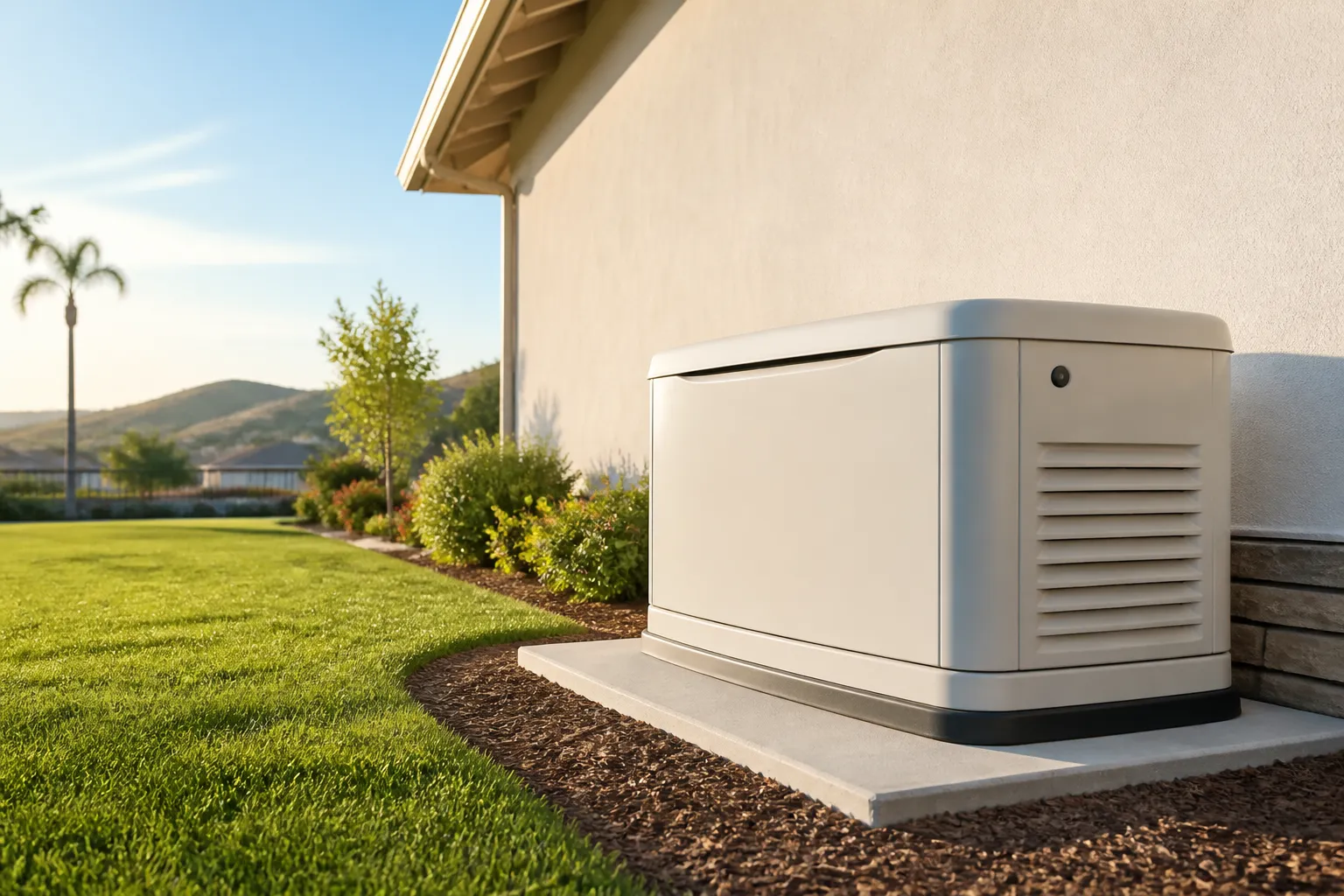
A whole-home standby generator installed in San Diego County typically lands between $14,000 and $27,000, all in. That is a wide range, and the width is the point: the number depends on four things that are specific to your address.
Below is what actually drives the price, and a calculator that will give you a real range for your own home in a few minutes.
What decides the price
1. What you want running
This is the largest single factor. Powering essential circuits — refrigeration, heat, a few outlets, the well pump — needs a much smaller unit than running the whole house including air conditioning. The load calculation comes first, and the generator is sized to it.
2. Your existing panel
A generator ties into your electrical service through a transfer switch. If your panel is at capacity, is an older or discontinued type, or is undersized for the addition, that work happens before the generator goes in. A 200-amp service upgrade in San Diego County typically runs $2,800 to $4,200 on its own.
3. Gas supply and distance
Natural gas is usually simplest because there is no tank to refill, but the meter has to be able to carry the generator alongside your existing appliances. Properties without gas service run on propane, sized to the runtime you want. Either way, the distance from the gas source to the pad is real pipe and real trenching, and it goes up sharply if the run has to cross a driveway or patio.
4. Where the unit sits
Distance from both the meter and the panel drives labour and materials. Code also sets minimum clearances from windows, doors and vents, which sometimes rules out the obvious spot and pushes the unit further from both connection points.
What a complete installation includes
- The generator, sized to your load calculation
- Concrete pad and setting
- Gas line from the meter or tank
- Automatic transfer switch wired into your panel
- Any panel or service work the install requires
- Permit for your jurisdiction and SDG&E coordination
- Final inspection
- Commissioning, a live transfer test, and warranty registration
A quote that is materially cheaper than the ranges above is usually missing one of these. Permits and panel work are the two most common omissions, and both surface later as change orders.
Get a real number for your home
The calculator below asks about your home, your panel, your gas service and where the unit would sit. At the end it shows you a price range and a recommended model. It takes a few minutes and there is no obligation.
Common questions about cost
Is financing available?
Yes, on approved credit. Most homeowners find it easier to evaluate once they have a range and know what they are budgeting against.
Does a generator add value to the home?
In areas subject to public safety power shutoffs it is increasingly treated as a feature rather than an extra, in the same way air conditioning is. It is also a documented, permitted improvement, which matters at sale.
What does it cost to run?
Fuel only while it is running. A natural gas unit uses gas at a rate that depends on load, and most homeowners find a multi-day outage costs less in fuel than the food they would otherwise lose. Budget $250 to $500 a year for annual service.
Why are portable generators so much cheaper?
They solve a different problem. A portable needs someone home, awake and able to start and refuel it, and it powers what you can reach with cords. A standby unit is wired into the house and starts on its own. The price difference reflects the installation, not just the equipment.
How long does the whole process take?
Site visit and final quote usually within a week. From signed proposal to a running generator is typically several weeks, most of which is permitting and equipment lead time rather than days on site. The installation itself is usually one to two days.