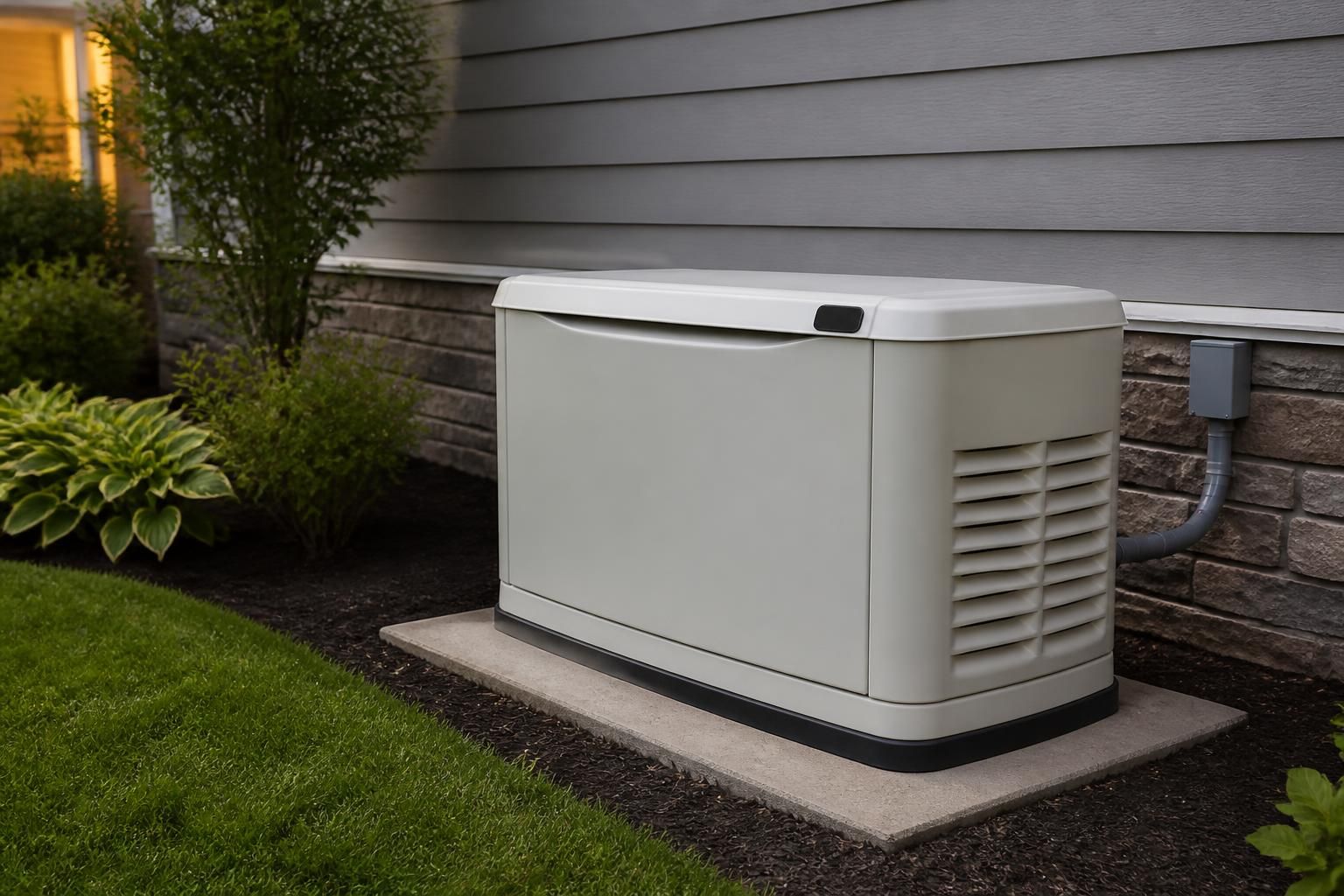
Standby generators fail in a specific and frustrating way: quietly, and at the exact moment you need them. The unit sat in the side yard for months looking fine, the power went out, and nothing happened. Or it started, ran for a few minutes, and shut itself down.
We diagnose and repair standby systems across San Diego County. Because we are a licensed electrical contractor rather than an engine shop, we look at the whole system, and that matters more than it sounds. A large share of what gets called a generator failure is not the generator.
The most common single cause is the battery. Standby units keep a battery charged for starting, and a battery that has quietly lost capacity produces exactly the symptom people describe as the generator being dead. It is also the cheapest thing on this list.
Fuel is the next. Units that sit for long periods can develop supply problems, and on a system that has not run under load in a year, the first real demand is when that surfaces.
Then there is the transfer equipment. If the generator starts and runs but the property stays dark, the generator is working and the transfer side is not. That is an electrical fault rather than a mechanical one, and it is the category most likely to be misdiagnosed by somebody looking only at the engine.
Finally there are control and sensor faults, where the unit is shutting itself down deliberately because it has detected a condition it does not like. Those are worth reading properly rather than overriding.
We start by getting the actual symptom rather than the summary. Does it crank? Does it start and stop? Does it run but never transfer? Does it only fail under load? Each of those points at a different part of the system, and the answer usually narrows the diagnosis before anyone opens a panel.
From there the work is systematic: verify the battery and charging circuit, confirm fuel supply, check the control board and any logged faults, then test the transfer switch and its control wiring under real conditions. Testing under load is the part that gets skipped, and it is the part that finds intermittent faults.
You get told what failed, why, and what the options are before any parts are ordered. If the honest answer is that the unit is near the end of its service life and repair money is better spent elsewhere, we will say that too.
There is a point where continued repair stops making sense. It is usually a combination of age, the cost of the specific failure, parts availability for that model, and how many times you have already been down this road.
We do not have a fixed rule for this because the honest answer depends on the unit and how much you rely on it. What we can do is lay out what the repair costs, what a replacement would involve, and let you make that call with real numbers rather than a sales pitch. If replacement is the direction, generator installation covers what that looks like.
A generator is only as useful as the electrical system it feeds. We regularly find units that were installed correctly as machines but tied into a panel that was already at its limit, or a transfer arrangement that was never commissioned properly.
Because we handle panel work and the wiring ourselves, a repair visit can address the actual root cause rather than stopping at the property line of somebody else's trade.
On a unit that has been sitting, the battery is the first thing to check and the most common culprit. It is also inexpensive to resolve. That said, do not assume it, because a failing charging circuit will kill a new battery too.
Probably not. That symptom points at the transfer equipment or its control wiring rather than the generator itself. It is an electrical fault, and it is one we see regularly.
The unit is likely protecting itself in response to something it has detected, or it is running into a fuel or load problem that only appears once it is actually working. Either way the shutdown is information, and reading the fault properly is the first step.
Yes. A good portion of the repair work we do is on systems installed by somebody else.
It depends on the age of the unit, the specific failure, and parts availability. We will give you the repair cost and what replacement would involve so you can compare the two honestly.
Largely, yes. Most of what we get called out for is preventable, which is the entire argument for generator maintenance and for keeping the unit on a regular service schedule rather than discovering problems during an outage.
Tell us what the unit is doing and roughly how old it is. That is usually enough to narrow the likely cause before a visit, which makes the visit shorter and the quote more accurate.
Generator repair sits within our generator services, alongside installation, maintenance, and the transfer and panel work that supports them.

Get Started
Share a few details about your generator or electrical project and we will help you understand the next best step, whether you are planning a standby installation, scheduling maintenance, or upgrading the electrical system that supports it.