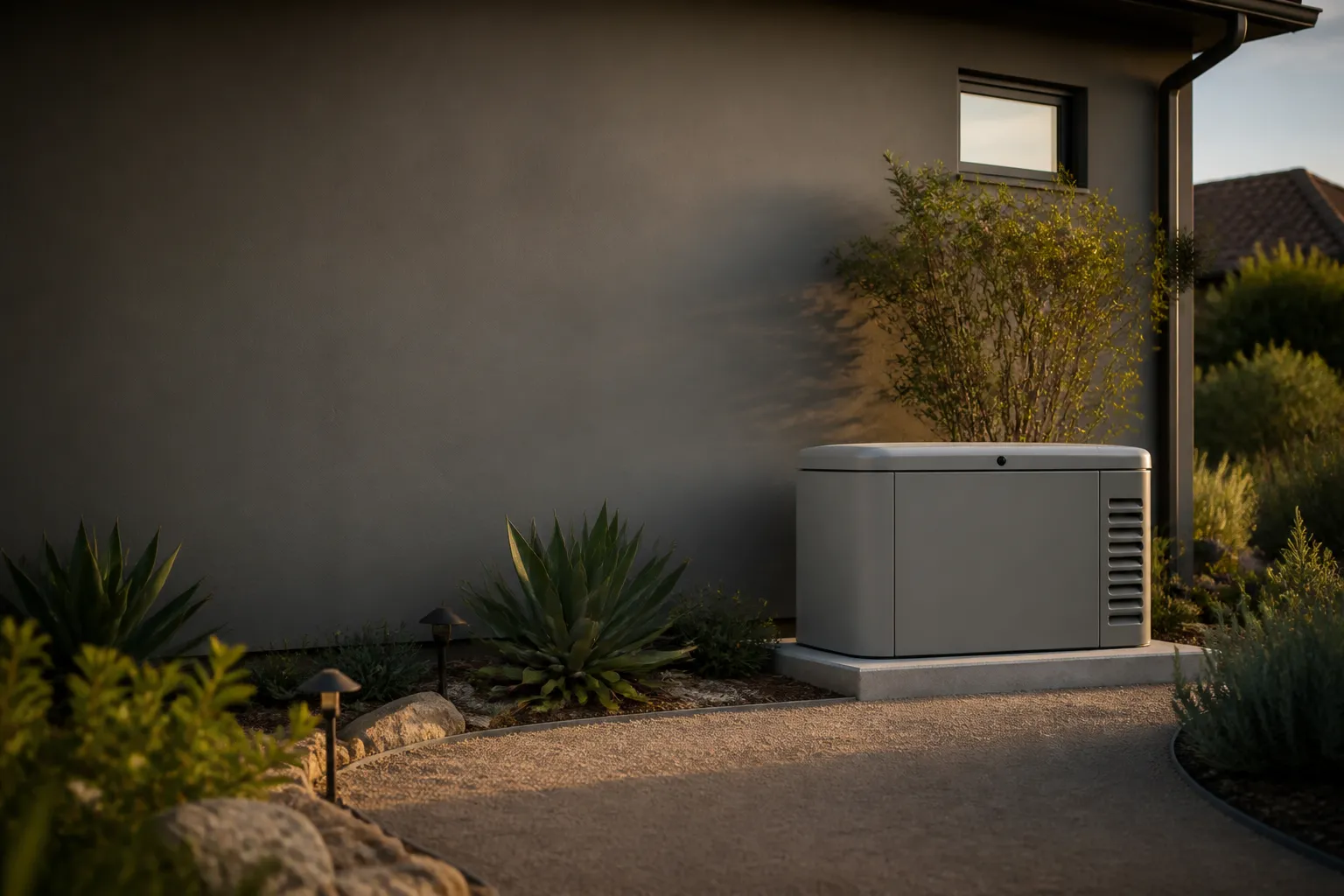
We supply and install standby generators for homes and businesses across San Diego County. The unit is only part of what you are buying, though, and treating it as the whole decision is how people end up with equipment that does not suit the property.
What you are actually buying is a system: a correctly sized unit, the transfer equipment, the panel work behind it, and an installation that has been commissioned and tested. Any one of those done badly undermines the rest.
The recommendation comes after sizing, not before. Until we know what has to stay running and what the starting loads look like, any specific unit is a guess.
Once the capacity is established, the choice narrows considerably on its own. From there the useful differences are fuel type, how the unit is controlled and monitored, sound output, physical footprint, and what parts and service support looks like locally over the years you will own it.
The practical decision for most properties here is natural gas versus propane, and it is usually settled by what the property already has. Natural gas means no storage and no refuelling, provided there is a supply. Propane requires a tank but works where there is no gas line, which covers a good deal of the backcountry.
Diesel appears more often on commercial installations. We will talk through what makes sense given the property, the supply situation, and how long you would want to run during an extended outage.
Sound output is the specification people regret ignoring. Standby units run a self-test regularly, which means the noise is not just an outage-day consideration, it is a recurring one for you and your neighbours.
Placement interacts with this and with code clearance requirements. We walk the property rather than deciding from a plan, because the difference between a good and a bad location is usually obvious on site and invisible on paper.
If a smaller unit covers what you actually need, we will say so. If the panel needs work first, we will say that before you order rather than after. And if what you want is not the right fit for the property, you will hear that too.
We quote per project because the variables are real: capacity, coverage scope, distance from panel to unit, panel condition, and fuel supply. A number given before those are known is a number that gets revised, and nobody enjoys that conversation.
Because we handle the electrical work ourselves, supply and installation are one scope rather than a handoff. That means the transfer equipment, the panel work, and the commissioning are all accounted for in the same quote.
Once installed, maintenance is what keeps the unit ready. A standby generator that is never serviced is an expensive assumption.
A quote from us covers the whole system rather than the unit with extras added later. That means the generator, the transfer equipment, the electrical connection and any panel work identified during assessment, permitting and utility coordination, the installation itself, and commissioning.
Commissioning is worth calling out because it is the step most easily skipped. The system gets tested under real transfer conditions before we leave, and you get walked through what the unit does on its own, what its indicators mean, and what to do if something looks wrong. You should have seen your generator work before you need it to.
Site preparation is scoped where it is needed. A unit needs a level, stable base with correct clearances, and what that involves varies with the ground and the location.
Manufacturer warranty terms differ by unit and by how the system is maintained, so we go through what applies to the specific model you are considering rather than making a general promise on the manufacturer's behalf.
What we will say plainly is that most warranty terms assume the unit is serviced, and a documented service history matters if a claim is ever needed. That is one of several reasons service plans are worth having in place from the start rather than added after a problem.
The installation is rarely the long part. Assessment, permitting, utility coordination, and unit availability account for most of the elapsed time, and availability in particular can move depending on the model and the season.
Demand for standby power rises predictably ahead of fire season and after any widely reported outage. If you are planning around a specific date, earlier is genuinely better, and we will tell you the realistic window rather than an optimistic one.
We size first and let that narrow the field, then look at fuel type, sound, control features, and local parts and service support. The right answer depends on the property rather than on a single make.
It varies enough that a figure without an assessment would be misleading. Capacity, coverage scope, the distance from panel to unit, and panel condition are the main drivers. You get a firm number before any work begins.
Talk to us before you buy. If it is correctly sized for the property, that is a conversation worth having. If it is not, we would rather tell you before the purchase than after.
Usually decided by what the property already has. Natural gas avoids storage and refuelling where a supply exists; propane works where it does not.
Most of the elapsed time is assessment, permitting, and utility coordination rather than the installation itself. We give you the realistic timeline up front.
Yes. See commercial standby generators.
Start with a conversation about the property and what has to stay running. Everything else follows from that.
Generator supply sits within our generator services.
Get Started
Share a few details about your generator or electrical project and we will help you understand the next best step, whether you are planning a standby installation, scheduling maintenance, or upgrading the electrical system that supports it.