Residential standby power is largely about comfort and inconvenience. Commercial standby power is about continuity. The question is not whether the lights are on, it is what an hour of downtime costs and which systems have to survive it for the business to keep operating.
That difference changes how the whole project gets scoped. We start from the operational consequence rather than from the building.
The list is specific to the business, but the recurring items are refrigeration, point-of-sale and payment systems, servers and networking, building access and security, lighting for safe occupancy, and any process equipment that is expensive or slow to restart.
Refrigeration and process equipment tend to dominate, because the loss is not only downtime, it is stock. For a restaurant, grocer, or anything holding perishable inventory, a single extended outage can cost more than the standby system.
Commercial work carries coordination that residential work does not. The service interruption during installation has to land somewhere that does not cost you a trading day. Access may be restricted to certain hours. There may be a landlord, a building manager, or a tenant agreement in the picture.
None of that is difficult, but all of it is planning, and it belongs in the schedule rather than surfacing on the day. We work the installation window around how the business actually operates.
Commercial sizing follows the same method as residential with a different priority order. The load list is built from operational necessity, then starting loads are added, then we look at what the existing electrical infrastructure will support.
Businesses more often end up closer to whole-facility coverage than homes do, simply because more of the load is genuinely essential. But partial coverage still deserves consideration, and we would rather show you both than assume the larger number.
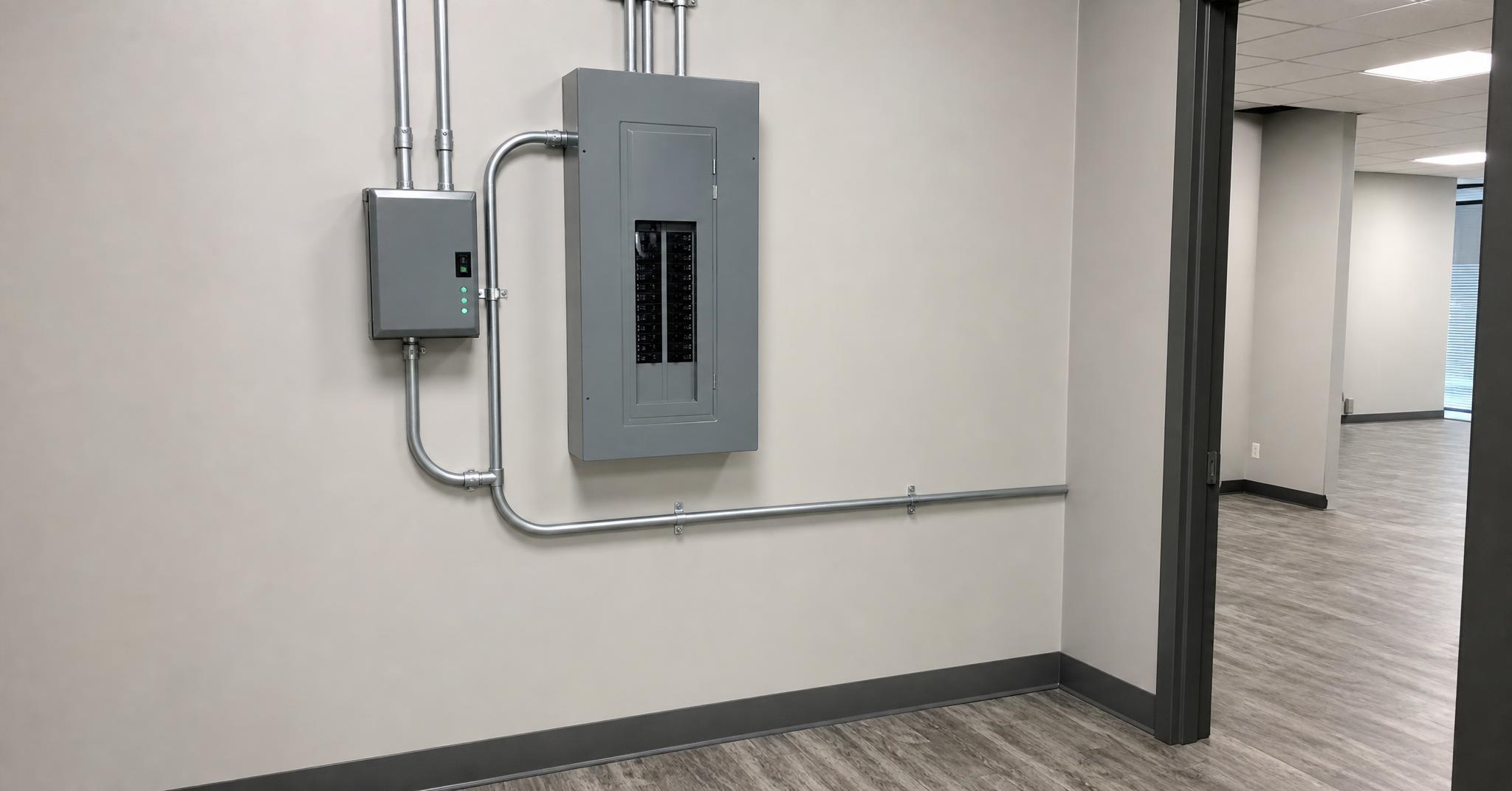
Commercial installations frequently involve subpanel work, and the transfer arrangement is often more involved than a residential equivalent because the load is distributed differently.
Because we handle panel and distribution work ourselves, that is scoped as part of the same project. It is not a separate trade arriving later with a separate quote.
A commercial standby system that has never been tested under load is a liability rather than an asset. Regular service matters more here than in a home, because more depends on it and because a failure during an outage is the most expensive possible moment to discover a problem.
Service plans cover scheduled testing and inspection so the system is verified on a routine rather than assumed to be fine.
Food service is the clearest case, because the loss during an outage is not only trading time but stock. Refrigeration and freezer capacity usually lead the load list, and the arithmetic on a single extended outage often justifies the system on its own.
Medical and dental practices carry equipment and records that cannot simply stop, along with obligations around patient safety that make an unplanned closure more serious than an inconvenience.
Retail depends on payment and access systems. A store with lights but no ability to take payment is closed in every way that matters.
Offices and any business running its own server or networking equipment need clean continuity rather than just power, and property managers are increasingly asked about backup for shared building systems such as access control, lifts, and life-safety equipment.
Commercial systems more often benefit from deliberate load prioritisation: deciding in advance what runs first and what can be shed if demand approaches capacity.
That allows a smaller and less expensive unit to cover genuinely critical systems reliably, rather than sizing for a worst case where everything runs simultaneously. It requires an honest ranking of what matters, which is a business conversation rather than a technical one, and it is worth having properly before the specification is fixed.
Businesses are more likely than homeowners to need evidence that a standby system has been maintained and tested, whether for insurance, a landlord, or a regulator depending on the sector.
Scheduled service produces that record as a by-product. It is worth having in place from the beginning rather than reconstructing later.
There is a power interruption while the transfer equipment is tied in. We schedule that around your operating hours and give you the window in advance so it lands somewhere manageable.
Not always. It depends on which systems are genuinely essential. We build the load list with you and show what full versus partial coverage each require.
It is workable, but the landlord or building manager needs to be part of the conversation early, since the work affects the service entrance. Bring us in before you have committed to anything.
More often than most are. The units self-test, but a self-test is not the same as a tested transfer under real load. That is what scheduled service is for.
Yes, including systems installed by somebody else. See generator repair if something is currently not working.
Tell us what the business does, what has to keep running, and what an hour of downtime costs you. That last answer shapes the whole recommendation.
Commercial work sits within our generator services.

Get Started
Share a few details about your generator or electrical project and we will help you understand the next best step, whether you are planning a standby installation, scheduling maintenance, or upgrading the electrical system that supports it.