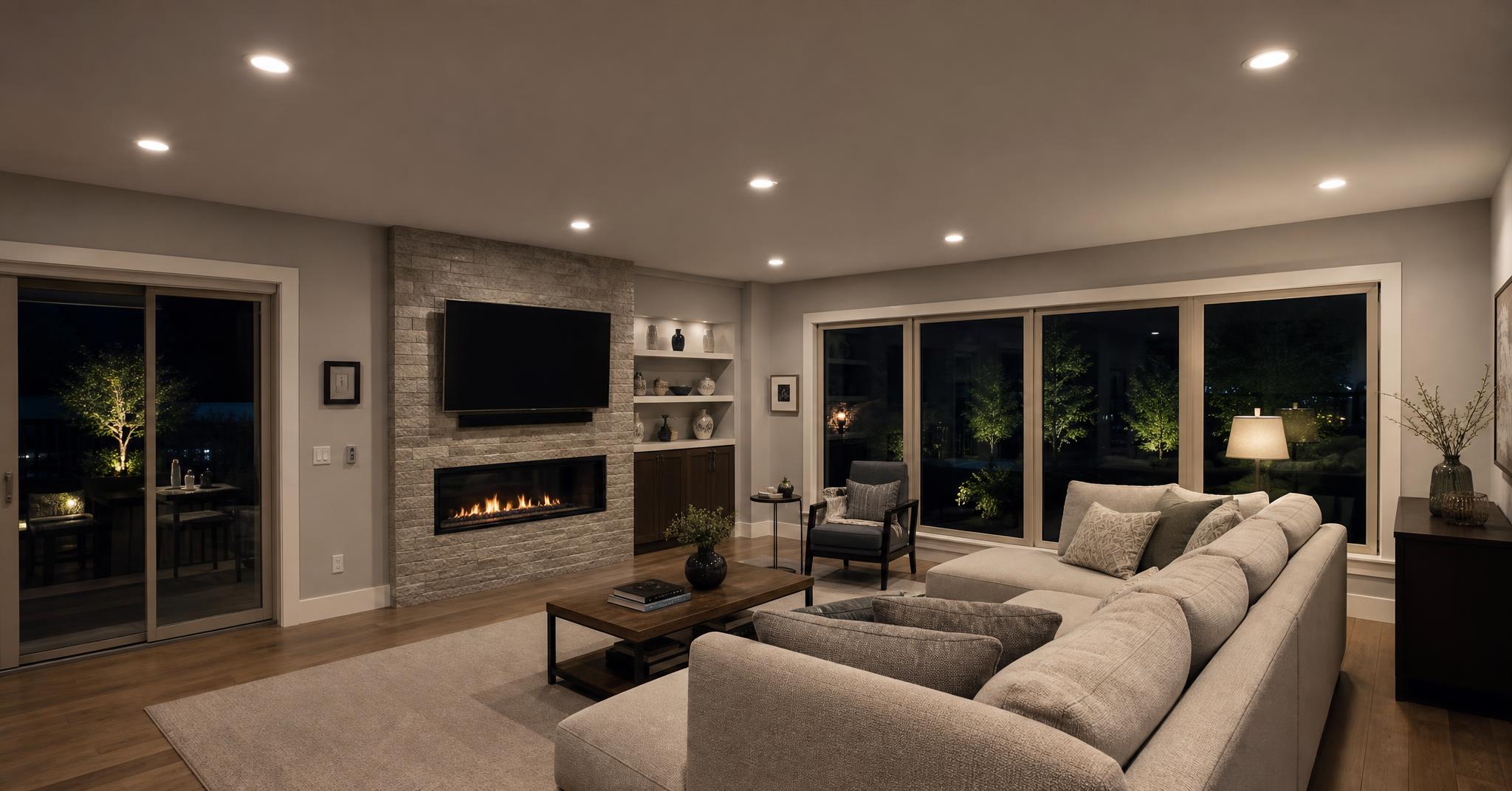
A good deal of lighting work is not new installation. It is replacing fixtures that are dated, failing, or throwing far less light than they used to, in ceilings that were finished decades ago and that nobody wants opened up again.
Retrofit work is about getting a better result without the disruption of starting over. Done properly it is one of the higher-impact, lower-mess projects available on an older property.
Three things usually stack up. The fixtures themselves have aged and the reflectors have dulled. The lamps are an older technology drawing more power for less usable light. And the original layout was planned around what those fixtures could do, which is not what current lighting can do.
That last one is why a straight one-for-one swap sometimes disappoints. The new lamps are better, but the placement is still solving a problem that no longer exists.
Converting older recessed lighting to LED is usually worth doing. The light quality is better, the power draw is lower, and the replacement interval is far longer, which matters on a high ceiling.
What we will not do is pretend every conversion is a simple lamp change. Some existing housings accept a retrofit insert cleanly. Others have dimming or transformer arrangements that do not play well with LED and produce flicker or buzz if you ignore it. We check which situation you are in before quoting rather than after you notice the flicker.
It is worth pausing on. Warmer light suits living spaces and reads as comfortable. Cooler light suits work areas and reads as clean, but in a lounge it feels clinical.
The mistake is mixing temperatures within a sightline, so one room reads warm and the adjoining one reads blue. If we are retrofitting part of a property, matching what stays is part of the planning.
Most retrofits work through the existing openings, which is what keeps them clean. Where we are adding fixtures rather than replacing them, that means new openings and access above the ceiling, and we will be straightforward about what that means for patching before starting.
Dimming is worth deciding at the same time. Retrofitting dimming later often means a switch change and sometimes a wiring change, and it is trivial to include while the work is already happening.
If the circuit is already overloaded, or the wiring above the ceiling is aged enough to be a concern, replacing fixtures makes the room look better and leaves the actual problem in place. We would rather tell you that and scope wiring services or a panel conversation properly.
Equally, if the existing layout is fundamentally wrong for how the room is used, a retrofit locks in that layout. Sometimes the honest recommendation is a small amount of new work rather than a like-for-like replacement.
The most common retrofit mistake is keeping the original count because it is the original count. Older recessed layouts were often planned around fixtures that threw a narrow, weak pool of light, so more of them were needed to cover a room.
Modern fixtures spread differently. Sometimes the same room works better with fewer, better-placed lights, which also means fewer holes and less to maintain.
Spacing is worth getting right rather than eyeballing. Too far apart and the room scallops into bright and dim patches. Too close and it flattens into a wash with no shape at all. Where the fixtures sit relative to walls matters as much as the gaps between them, because light grazing a wall does far more for a room than light landing in the middle of the floor.
The trim is the visible part and it does more than decoration. A baffle trim cuts glare, which matters in a room where people sit and look up. A reflector trim pushes more light down, which suits a kitchen. An adjustable trim lets you aim light at a wall, artwork, or a work surface.
Beam spread is the specification people never ask about and often notice afterwards. A narrow beam creates defined pools and drama. A wide beam gives even coverage. Neither is correct in isolation, but mixing them without intent is how a ceiling ends up looking accidental.
One genuinely important technical point on retrofits. Recessed fixtures generate heat, and where insulation sits against a fixture that is not rated for that contact, it is a real safety concern rather than a technicality.
Older properties frequently have insulation added at some point after the original lighting went in, with nobody checking the interaction. When we open a ceiling for a retrofit this is one of the things we look at, and if we find it we will tell you, because it is exactly the sort of thing that stays hidden until it matters.
In most cases yes, where we are working through existing openings. Adding new fixtures means new openings, and we will tell you what patching is involved before we start.
Sometimes. Older dimmers were designed for a different load and can cause flicker or buzz with LED. We check the dimmer alongside the fixture rather than assuming.
Warmer for living spaces, cooler for work areas. The thing to avoid is mixing temperatures within a sightline, which is far more noticeable than any individual choice.
Often, on power draw and replacement interval alone, particularly on high ceilings or fixtures that are awkward to reach. If the existing lighting genuinely suits the room, there is no urgency.
Yes. That is new work rather than retrofit, so it involves new openings and possibly a new circuit depending on what the existing one is already carrying.
Like-for-like fixture replacement generally does not. Adding circuits does. We will tell you which applies to your project.
Retrofit work sits within our lighting services, alongside interior lighting installation and outdoor lighting.

Get Started
Share a few details about your generator or electrical project and we will help you understand the next best step, whether you are planning a standby installation, scheduling maintenance, or upgrading the electrical system that supports it.