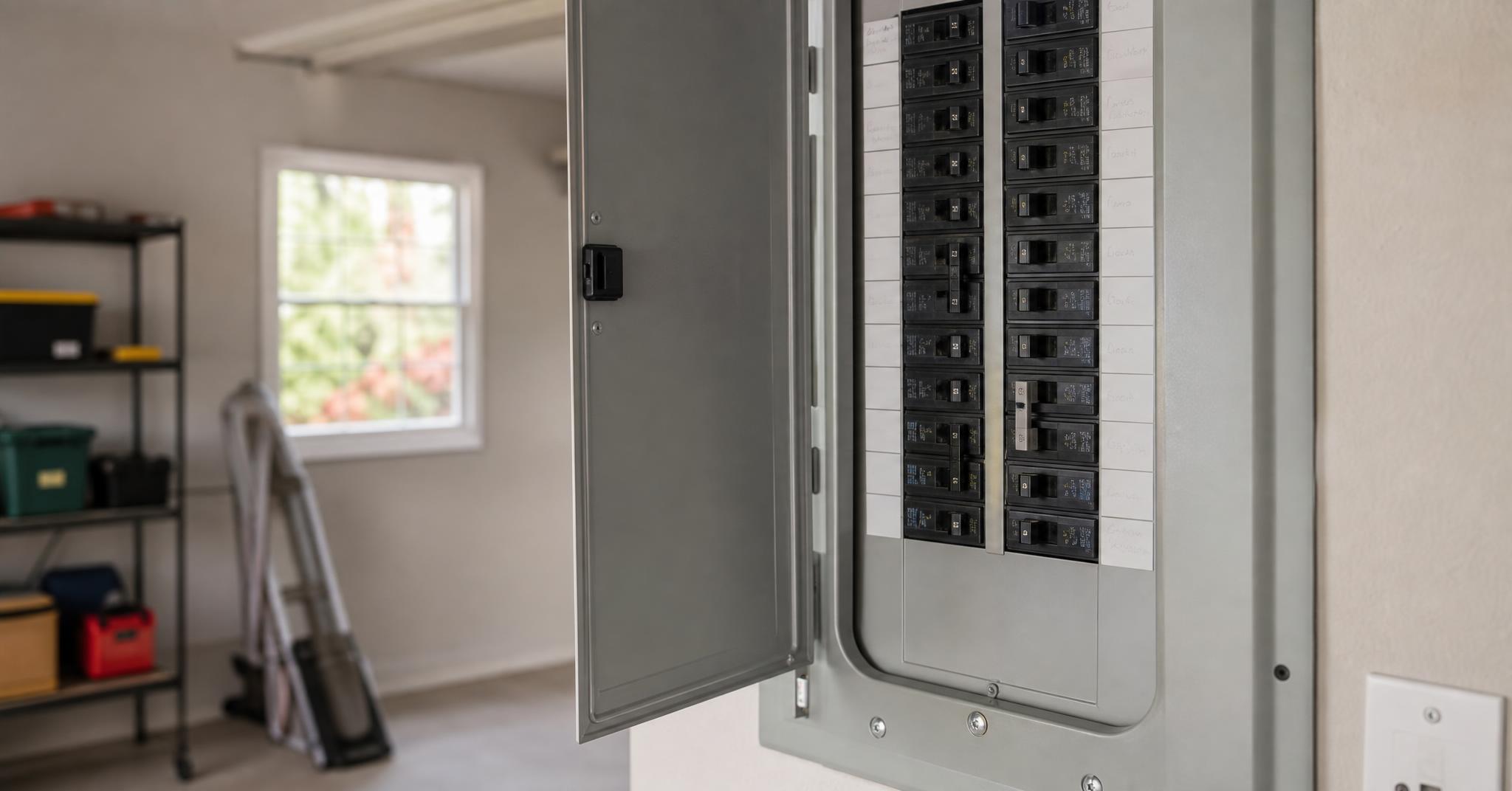
A tripping breaker is easy to resent, especially in the middle of a hot afternoon. But a breaker that trips is a breaker that is working. It is a safety device interrupting current before wiring overheats. The useful question is not how to stop it from tripping, but what is causing the trip in the first place.
The three common causes
Overload
The most frequent cause. Too much demand on one circuit, and the breaker opens. This often shows up in older homes where a single 15-amp circuit serves a whole room that now runs a window unit, a television, a computer, and a space heater. The tell is timing: the trip happens when you add that last device, and the circuit holds fine once you spread the load.
Short circuit
A hot conductor contacting a neutral or ground. This trips immediately and hard, often with a visible scorch mark, a sharp sound, or a burning smell at an outlet or fixture. A short is not something to reset repeatedly. If you suspect one, leave the breaker off and have the circuit inspected.
Ground fault
Current finding an unintended path to ground, often through moisture. Common in kitchens, bathrooms, laundry areas, garages, and outdoor receptacles. GFCI devices are designed to catch this, and a GFCI that trips regularly in a damp location is often pointing at a real problem rather than being oversensitive.
What the pattern tells you
- Trips only under heavy load: likely an overload, and possibly a circuit that needs to be split or a panel that needs more capacity.
- Trips immediately on reset: points toward a short or a fault on the circuit, not a load problem.
- Trips at random with nothing obvious running: can indicate a deteriorating breaker, a loose connection, or intermittent moisture intrusion.
- The main breaker trips: a different situation entirely, and worth professional diagnosis rather than repeated resets.
What not to do
Do not replace a breaker with a higher-amperage one to make the tripping stop. The breaker is sized to the wire behind it. A larger breaker on undersized wire removes the protection without removing the problem, and the wire becomes the weakest link.
Also worth noting: breakers are mechanical devices and they wear. A breaker that has tripped many times over many years can begin failing to reset, or begin tripping below its rated load.
When to bring in an electrician
Call when a breaker will not reset, when resetting is becoming routine, when you notice heat, discoloration, or a burning smell at the panel, or when you cannot identify what is on the circuit. Peak Power Systems starts these calls with an on-site diagnosis rather than a parts swap, because the fix depends entirely on which of the causes above is actually at work.